Explore Our Books

Where research, expertise, and ideas come together.
Explore specialized books written by our researchers to inspire new perspectives, deepen understanding, and advance knowledge.

Explore the Collection
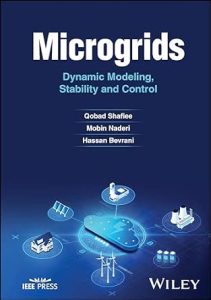
Cover of Microgrids: Dynamic Modeling, Stability and Control
WILEY, IEEE PRESS 2023

Microgrids: Dynamic Modeling, Stability and Control

Microgrids: Dynamic Modeling, Stability and Control, provides comprehensive coverage of microgrid modeling, stability, and control, alongside new relevant perspectives and research outcomes, with vital information on several microgrid modeling methods, stability analysis methodologies and control synthesis approaches that are supported by real-time simulations and experimental studies for active learning in professionals and students alike.

This book is divided into two parts: individual microgrids and interconnected microgrids. Both parts provide individual chapters on modeling, stability, and control, providing comprehensive information on the background, concepts, and architecture, supported by several examples and corresponding source codes/simulation files. Communication based control and cyber security of microgrids are addressed and new outcomes and advances in interconnected microgrids are discussed.

Publisher page
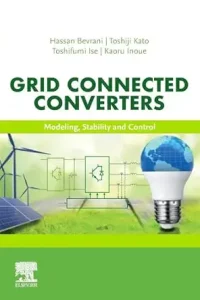
Cover of Grid Connected Converters: Modeling, Stability and Control
Elsevier 2022

Grid Connected Converters: Modeling, Stability and Control

Grid Connected Converters: Modeling, Stability and Control discusses the foundations and core applications of this diverse field, from structure, modeling and dynamic equivalencing through power and microgrids dynamics and stability, before moving on to controller synthesis methodologies for a powerful range of applications. The work opens with physical constraints and engineering aspects of advanced control schemes. Robust and adaptive control strategies are evaluated using real-time simulation and experimental studies. Once foundations have been established, the work goes on to address new technical challenges such as virtual synchronous generators and synergic inertia emulation in response to low inertia challenges in modern power grids.

Publisher page
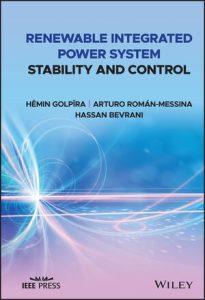
Cover of Renewable Integrated Power System Stability and Control
WILEY, IEEE PRESS 2021

Renewable Integrated Power System Stability and Control

This interdisciplinary resource explores the dynamics and control of power grids with high renewable penetration. It covers penetrated grid modeling, dynamic equivalencing, and model reduction, alongside challenges like reduced inertia and control level requirements. The book highlights virtual synchronous generators and their impact on system performance, as well as engineering constraints in advanced control schemes. It also presents robust and adaptive control strategies validated through real-time simulations and experiments.

Key topics include:

  • Time horizon studies, grid structure, generation options, storage systems, and microgrids
  • Host grid modeling and MG equivalent models
  • Virtual inertia and stability enhancement
  • Small-signal stability and frequency-domain analysis

Ideal for engineers, grid operators, and electrical engineering students seeking deeper insight into modern renewable-integrated power systems.

Publisher page
Cover of Optimization in Electrical Engineering
Springer 2019

Optimization in Electrical Engineering

This textbook provides students, researchers, and engineers in the area of electrical engineering with advanced mathematical optimization methods. Presented in a readable format, this book highlights fundamental concepts of advanced optimization used in electrical engineering. Chapters provide a collection that ranges from simple yet important concepts such as unconstrained optimization to highly advanced topics such as linear matrix inequalities and artificial intelligence-based optimization methodologies. The reader is motivated to engage with the content via numerous application examples of optimization in the area of electrical engineering. The book begins with an extended review of linear algebra that is a prerequisite to mathematical optimization. It then precedes with unconstrained optimization, convex programming, duality, linear matrix inequality, and intelligent optimization methods.

Publisher page
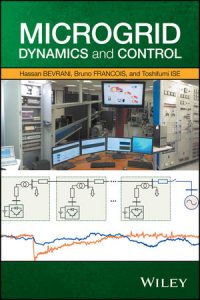
Cover of Microgrid Dynamics and Control
WILEY 2017

Microgrid Dynamics and Control

This book discusses relevant microgrid technologies in the context of integrating renewable energy and also addresses challenging issues. The authors summarize long term academic and research outcomes and contributions. In addition, this book is influenced by the authors’ practical experiences on microgrids (MGs), electric network monitoring, and control and power electronic systems. A thorough discussion of the basic principles of MG modeling and operating issues are provided. The MG structure, types, operating modes, modeling, dynamics, and control levels are covered. Recent advances in DC microgrids, virtual synchronous generators, MG planning, and energy management are examined. The physical constraints and engineering aspects of the MGs are covered, and developed robust and intelligent control strategies are discussed using real-time simulations and experimental studies.

Publisher page
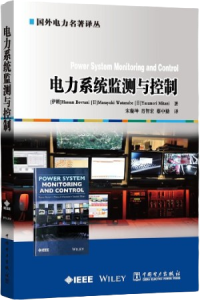
Cover of Chinese version of Power System Monitoring and Control
IEEE, WILEY 2016

Chinese version of Power System Monitoring and Control

Power System Monitoring and Control (PSMC) is becoming increasingly significant in the design, planning, and operation of modern electric power systems. In response to the existing challenge of integrating advanced metering, computation, communication, and control into appropriate levels of PSMC, Power System Monitoring and Control presents a comprehensive overview of the basic principles and key technologies for the monitoring, protection, and control of contemporary wide-area power systems. A variety of topical issues are addressed, including renewable energy sources, smart grids, wide-area stabilizing, coordinated voltage regulation, and angle oscillation damping-as well as the advantages of phasor measurement units (PMUs) and global positioning systems (GPS) time signal.

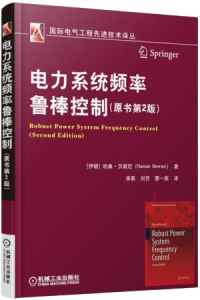
Cover of Chinese version of Robust Power System Frequency Control
Springer 2016

Chinese version of Robust Power System Frequency Control

Frequency control as a major function of automatic generation control is one of the important control problems in electric power system design and operation and is becoming more significant today due to the increasing size, changing structure, emerging new uncertainties, environmental constraints, and the complexity of power systems. Robust Power System Frequency Control uses the recent development of linear robust control theory to provide practical, systematic, fast, and flexible algorithms for the tuning of power system load-frequency controllers. The physical constraints and important challenges related to the frequency regulation issue in a deregulated environment are emphasized, and most results are supplemented by real-time simulations.

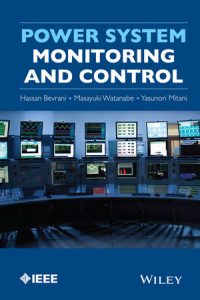
Cover of Power System Monitoring and Control
IEEE, WILEY 2014

Power System Monitoring and Control

Power System Monitoring and Control (PSMC) is becoming increasingly significant in the design, planning, and operation of modern electric power systems. In response to the existing challenge of integrating advanced metering, computation, communication, and control into appropriate levels of PSMC, Power System Monitoring and Control presents a comprehensive overview of the basic principles and key technologies for the monitoring, protection, and control of contemporary wide-area power systems. A variety of topical issues are addressed, including renewable energy sources, smart grids, wide-area stabilizing, coordinated voltage regulation, and angle oscillation damping—as well as the advantages of phasor measurement units (PMUs) and global positioning systems (GPS) time signal. End-of-chapter problems and solutions, along with case studies, add depth and clarity to all topics.

Publisher page
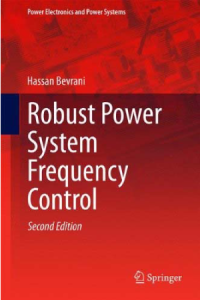
Cover of Robust Power System Frequency Control, Second Edition
Springer 2014

Robust Power System Frequency Control, Second Edition

Frequency control as a major function of automatic generation control is one of the important control problems in electric power system design and operation and is becoming more significant today due to the increasing size, changing structure, emerging new uncertainties, environmental constraints, and the complexity of power systems. Robust Power System Frequency Control uses the recent development of linear robust control theory to provide practical, systematic, fast, and flexible algorithms for the tuning of power system load-frequency controllers. The physical constraints and important challenges related to the frequency regulation issue in a deregulated environment are emphasized, and most results are supplemented by real-time simulations.

Publisher page
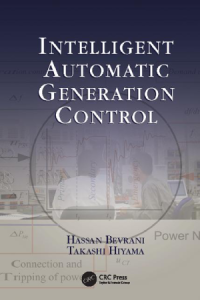
Cover of Intelligent Automatic Generation Control
CRC Press 2011

Intelligent Automatic Generation Control

Automatic generation control (AGC) is one of the most important control problems in the design and operation of interconnected power systems. Its significance continues to grow as a result of several factors: the changing structure and increasing size, complexity, and functionality of power systems, the rapid emergence (and uncertainty) of renewable energy sources, developments in power generation/consumption technologies, and environmental constraints. Delving into the fundamentals of power system AGC, Intelligent Automatic Generation Control explores ways to make the infrastructures of tomorrow smarter and more flexible. These frameworks must be able to handle complex multi-objective regulation optimization problems, and they must be highly diversified in terms of policies, control strategies, and wide distribution in demand and supply sources—all via an intelligent scheme.

Publisher page
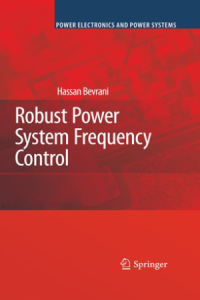
Cover of Robust Power System Frequency Control, First Edition
Springer 2009

Robust Power System Frequency Control, First Edition

Frequency control as a major function of automatic generation control is one of the important control problems in electric power system design and operation and is becoming more significant today due to the increasing size, changing structure, emerging new uncertainties, environmental constraints, and the complexity of power systems. Robust Power System Frequency Control uses the recent development of linear robust control theory to provide practical, systematic, fast, and flexible algorithms for the tuning of power system load-frequency controllers. The physical constraints and important challenges related to the frequency regulation issue in a deregulated environment are emphasized, and most results are supplemented by real-time simulations.

Publisher page