
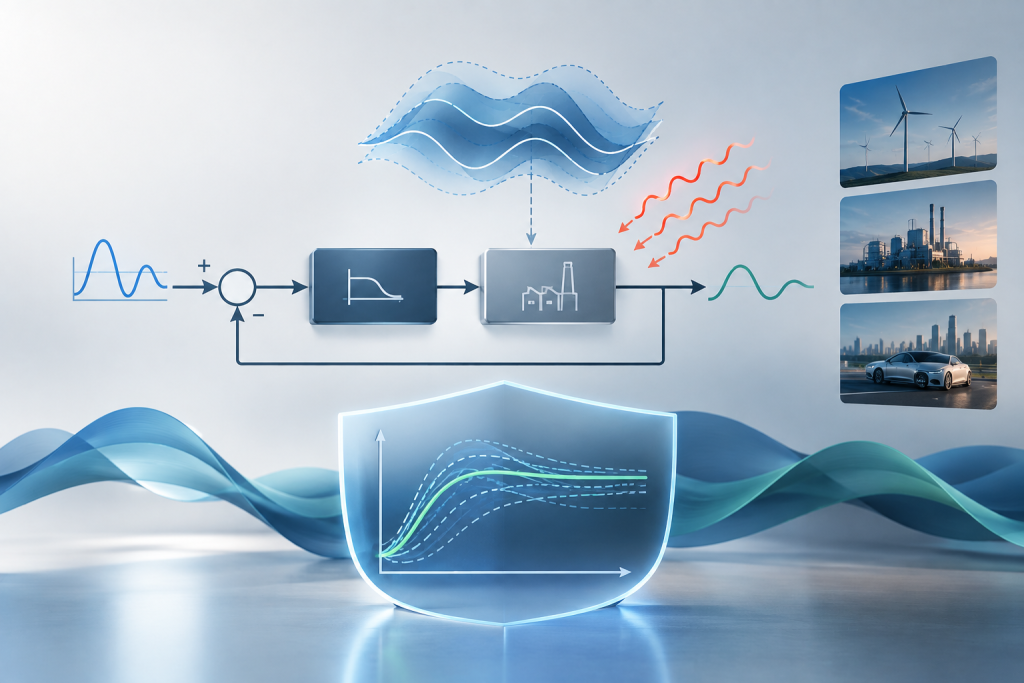
What You'll Learn
- How uncertainty is represented and how nominal stability differs from robust stability and robust performance.
- How system norms, sensitivity functions, small-gain reasoning, H2, H∞, μ analysis, and LMI-based methods are used in robust control.
- How to formulate, analyze, and solve robust control problems using both theoretical reasoning and computational tools.
Course Description
Real engineering systems are never identical to their mathematical models. Robust control begins with this reality and asks a fundamental question: How much uncertainty can a controlled system tolerate while remaining stable and performing as intended?
The course begins with nominal versus robust behavior, model uncertainty, sensitivity functions, the general control configuration, the small-gain theorem, and mathematical norms for signals, systems, and MIMO systems. Different representations of uncertainty are then introduced and connected to robust stability and robust performance.
The course progresses toward robust controller parameterization, model matching, H2 and H∞ methods, mixed-sensitivity design, H2/H∞ synthesis, structured singular value (μ) analysis and synthesis, controller simplification, and LMI-based control design. QFT is also introduced as an alternative robustness perspective.
Analytical concepts are complemented by engineering examples and computational investigation using relevant MATLAB robust-control and LMI tools. A student project connects the theoretical material to an actual robust-control problem.
Teaching & Evaluation Method
Topics
- Robust Stability
- Uncertainty
- H∞ Control
- μ-Analysis
- LMI
Course Files
Instructor
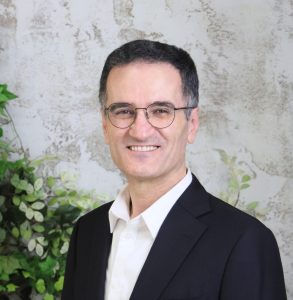
Prof. Hassan BEVRANI
IEEE Fellow
Hassan Bevrani received a Ph.D. degree in Electrical Engineering (Control Systems) from Osaka University in 2004. He is currently a full professor and the Founder of the Micro/Smart Grids Research Center (SMGRC) at the University of Kurdistan. Over the years, he has worked as an invited and visiting professor at several universities in Iran, Japan, Australia, France, Germany, and China. He is the author/coauthor of 10 international books, 18 book chapters, and over 500 journal/conference papers. Prof. Bevrani is a Fellow member of IEEE, the chairman of the Control Chapter of the IEEE Iran Section, and head of the Promotion Committee of the IEEE Iran Section. He was awarded the Allameh Tabatabaei Scientific Medal (National Foundation of Iranian Elites, 2025), an Outstanding Professor (Iran Ministry of Science, Research and Technology, 2022), IEEE Lifetime Research Award (IEEE Iran Section, 2025), and a Distinguished Professor in Electrical Engineering (Iran Academy of Science, 2025). Prof. Bevrani has also been awarded the prestigious Medal for the Promotion of Electrical Engineering Science by the Institute of Electrical Engineers of Japan (IEEJ) in 2026. His current research interests include microgrid operation and control, power system stability, and intelligent and robust control applications in the electric power industry.