
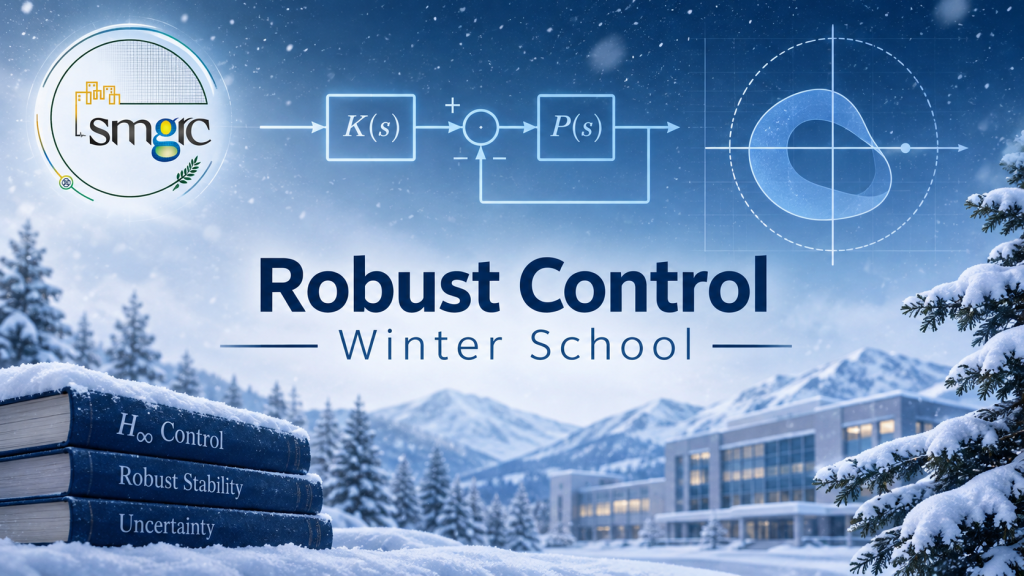
Robust Control Winter School
A three-day intensive school on applied robust control analysis and synthesis, with an emphasis on power systems and microgrids. Expert lectures are supported by hands-on simulation and MATLAB exercises
Description
In control theory, Robust Control contains a class of approaches that are used to controllers synthesis in the presence of uncertainties and disturbances. Therefore, robust control methods aim to achieve robust stability and/or robust performance in an uncertain environment including bounded modeling errors, parameters perturbation, and unmodeled dynamics. Although the early bases required tools go back to more than 80 years ago, the main start point of the theory of robust control took shape in the 1980s and 1990s. In contrast with an adaptive/intelligent control policy, a robust control policy is static, rather than adapting to measurements of variations, the structure of the controller is usually fixed, and it is designed to work assuming that certain parameters/variables will be unknown but bounded.
Historically and from the closed-loop transfer function perspective, a high open-loop gain, which its principle was already well understood by Bode and Black in 1927, leads to substantial disturbance rejection in the face of system parameter uncertainty. Thus, high-gain feedback is a simple example of a robust control method; because it allows simplified models of operational amplifiers and emitter-degenerated bipolar transistors to be used in a variety of different settings. But the major obstacle to achieving high loop gains is the need to maintain system closed-loop stability. Loop shaping may provide a solution to fix this challenge.
Some of the modern examples of robust control techniques are Hꚙ, structured singular value (μ), sliding mode control (SMC), robust LQG, quantitative feedback theory (QFT), and Kharitonov’s theorem. The control laws given by many robust control methodologies such as Hꚙ, H2, mixed H2/Hꚙ, and μ may be represented by high order transfer functions required to accomplish desired performance and stable robust closed-loop operation, simultaneously. Therefore, order reduction after the controller design process may be required.
In this winter school, the attendances will find useful knowledge on applied robust control analysis and synthesis. Therefore, the given lectures emphasize application perspectives, particularly in power systems and microgrids. Several relevant important topics and methodologies including Hꚙ, structured singular value (μ), sliding mode control (SMC), linear quadratic optimal control, model predictive control (MPC), quantitative feedback theory (QFT), and fuzzy robust control are addressed. The lectures are supplemented by simulation/application examples.
Courses
- An Introduction on Robust Controlby Prof. Hassan Bevrani
- Uncertainty and loop shaping control designby Prof. Hassan Bevrani
- Practical 𝐻 ∞ and Mu control synthesisby Prof. Hassan Bevrani
- Quantitative feedback Theoryby Dr. Yazdan Batmani
- Linear quadratic optimal control designby Dr. Qobad Shafiee
- Robust model predictive controlby Dr. Qobad Shafiee
- Fuzzy robust control scheme- Part Iby Dr. Barmak Baigzadehnoe
- Fuzzy robust control scheme- Part IIby Dr. Barmak Baigzadehnoe
- An introduction on sliding mode controllersby Dr. Yazdan Batmani
Presenters: Prof. Hassan Bevrani, Dr. Qobad Shafiee, Dr. Yazdan Batmani, Dr. Barmak Baigzadehnoe
What You Will Learn
- An Introduction on Robust Control
- Uncertainty and loop shaping control design
- Practical H-infinity and Mu control synthesis
- Quantitative feedback Theory
- Linear quadratic optimal control design
- Robust model predictive control
- Fuzzy robust control scheme
- An introduction on sliding mode controllers
Schedule & Courses
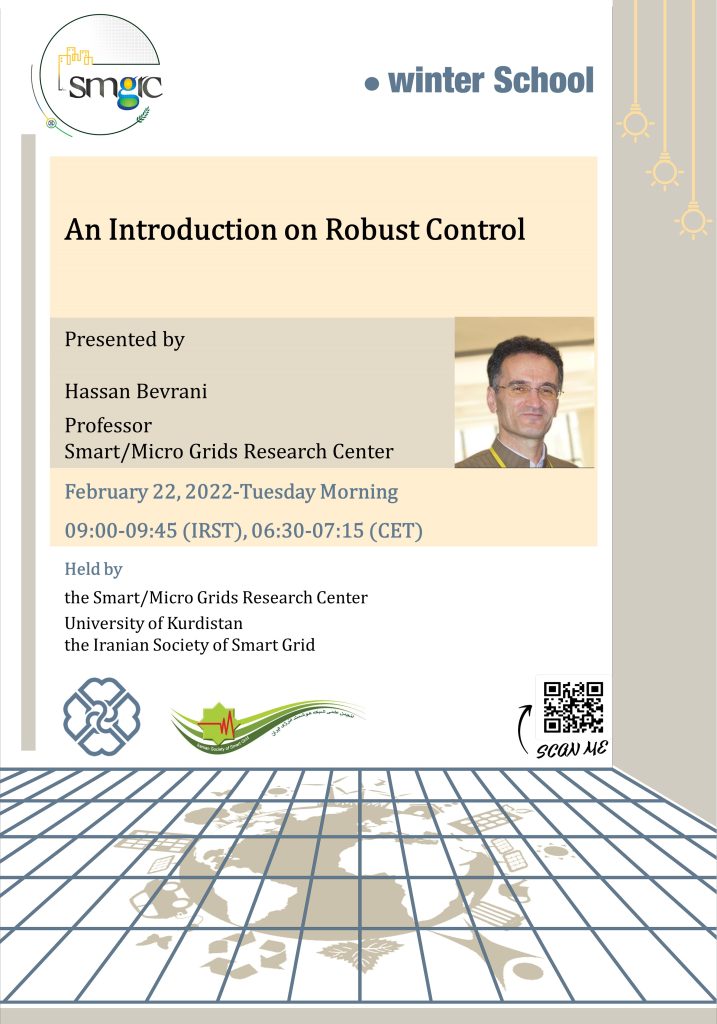
An Introduction on Robust Control

Prof. Hassan Bevrani
PROFESSOR | IEEE FELLOWRobust Control focuses on designing controllers that ensure system stability and performance despite uncertainties, disturbances, and modeling errors. This lecture introduces its fundamental concepts, key methods (such as H∞, μ-synthesis, and Sliding Mode Control), historical background, and differences from other control approaches. It provides a concise foundation for understanding Robust Control theory.
View details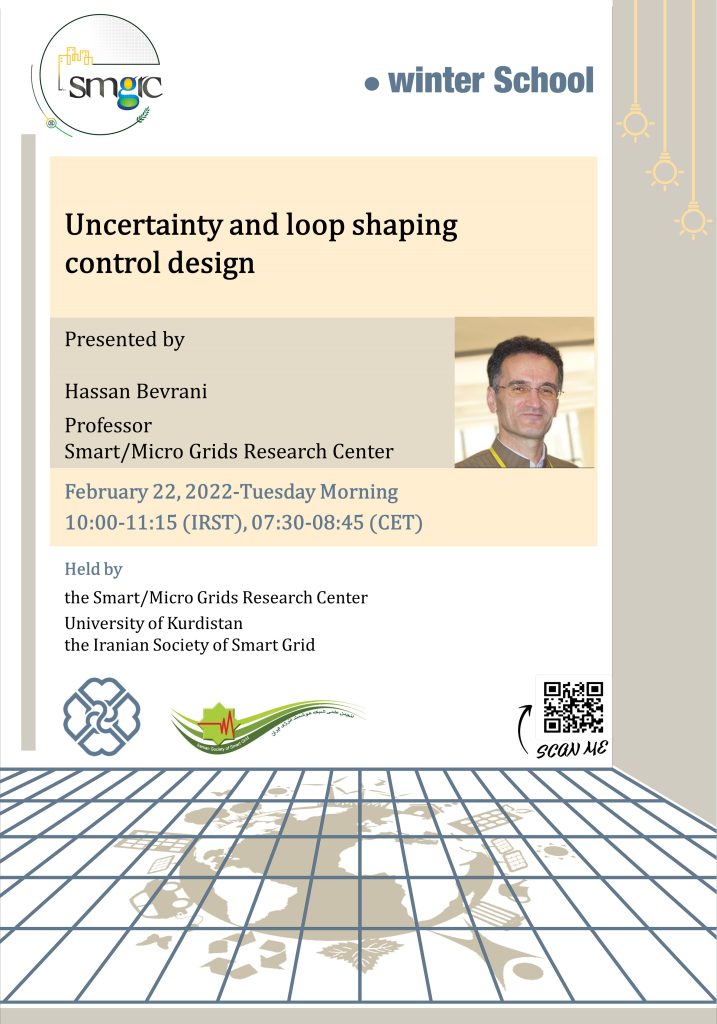
Uncertainty and loop shaping control design
Prof. Hassan Bevrani
PROFESSOR | IEEE FELLOWThis lecture covers the fundamentals of Robust and H∞ Control, focusing on uncertainty modeling, loop-shaping techniques, and robust stability analysis using the Small Gain Theorem. It explores controller analysis and synthesis for SISO and MIMO systems, performance weighting functions, Kharitonov’s theorem, and structured singular value (μ) methods.
View details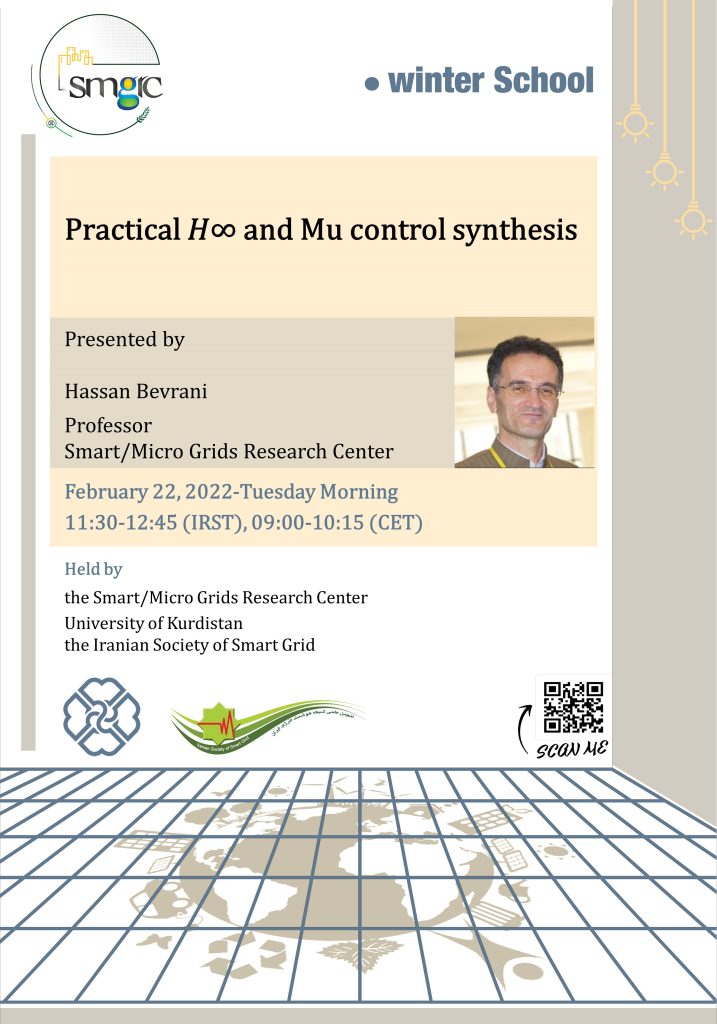
Practical 𝐻 ∞ and Mu control synthesis
Prof. Hassan Bevrani
PROFESSOR | IEEE FELLOWThis lecture focuses on practical robust control design using simple controller structures, particularly Static Output Feedback (SOF) and PI/PID controllers. It explores LMI-based synthesis methods, robust controller optimization, and real-world applications, including load-frequency control in power systems and damping control of grid-forming converters in microgrids.
View details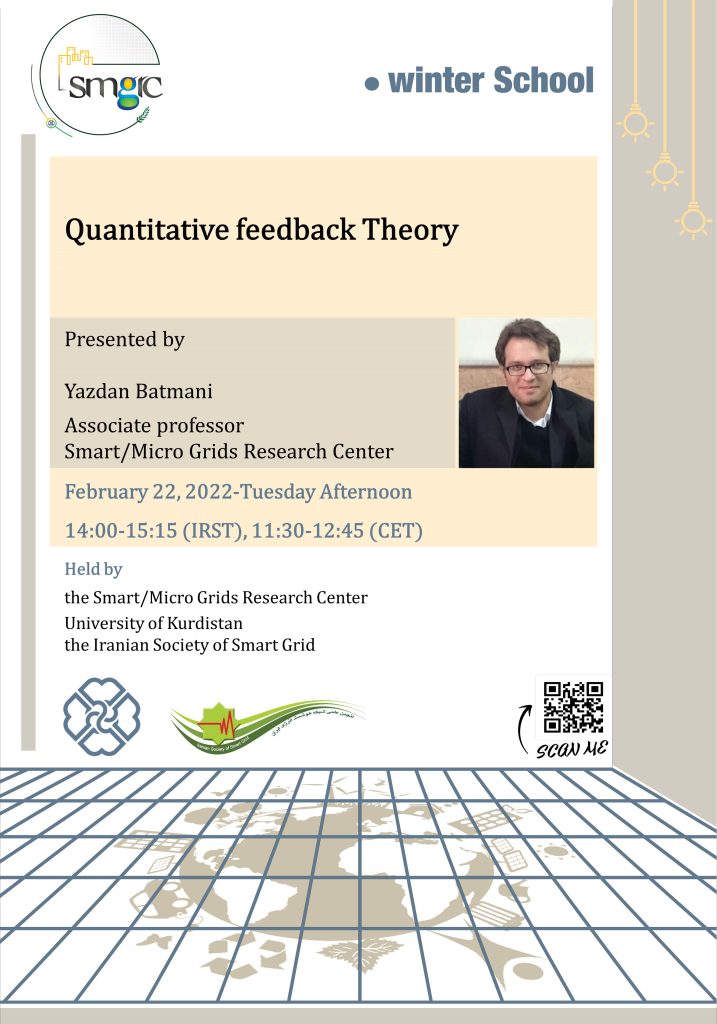
Quantitative feedback Theory
Dr. Yazdan Batmani
Associate ProfessorThis lecture introduces Quantitative Feedback Theory (QFT), a frequency-domain approach for designing robust controllers using the Nichols chart. It focuses on applying QFT to achieve robust stability and performance, particularly for PID controller tuning, with practical examples and MATLAB toolboxes. Participants will learn to design low-order robust controllers for a wide range of dynamical systems.
View details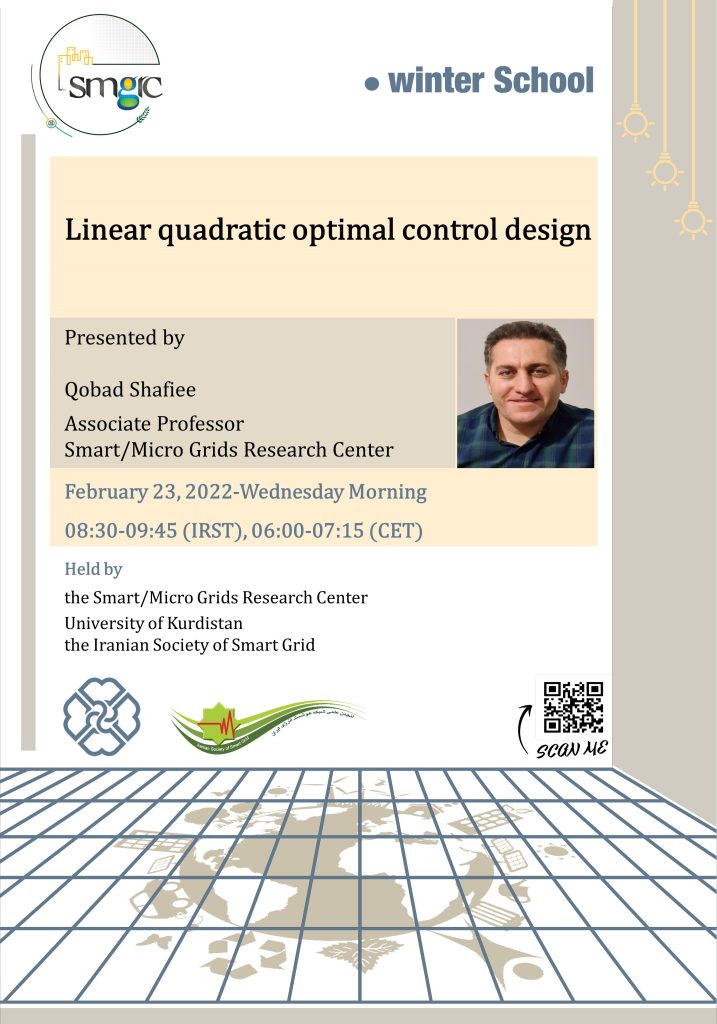
Linear quadratic optimal control design

Dr. Qobad Shafiee
Associate ProfessorThis lecture introduces Optimal Control Theory, focusing on finding optimal control strategies for linear and nonlinear dynamical systems while minimizing a given cost function. It explores Linear-Quadratic (LQ) optimal control, fundamental theoretical approaches, and practical applications through numerical examples and simulations.
View details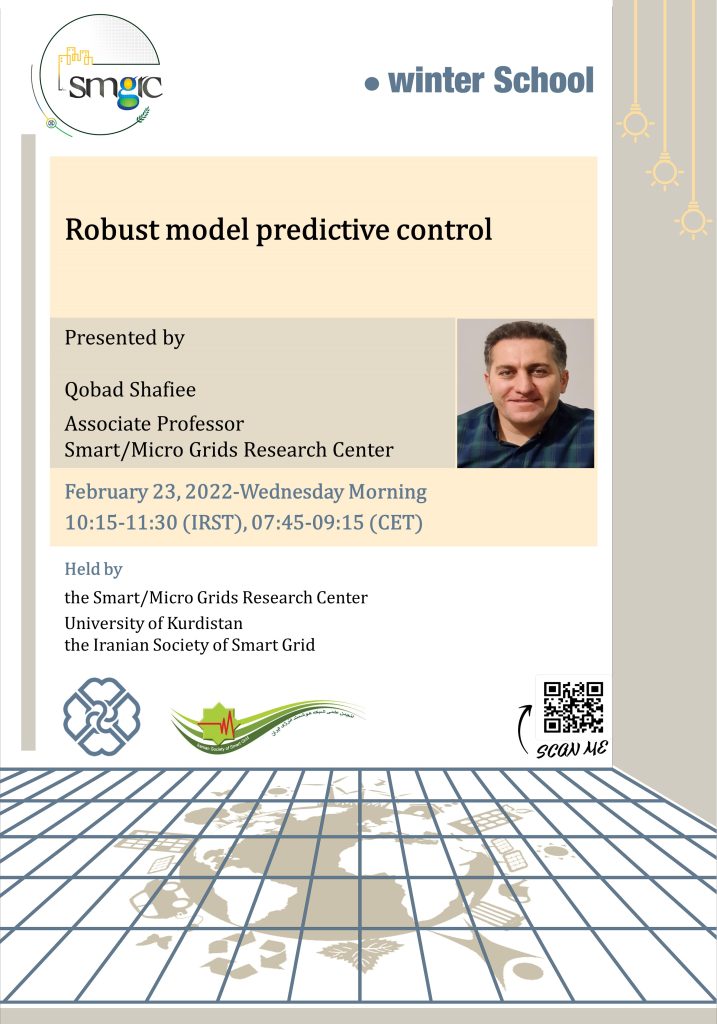
Robust model predictive control
Dr. Qobad Shafiee
Associate ProfessorThis lecture introduces Model Predictive Control (MPC), focusing on its fundamental principles, optimization-based control design, and handling of system constraints and uncertainties. It explores different MPC approaches, with particular emphasis on Robust MPC, supported by practical examples and simulations.
View details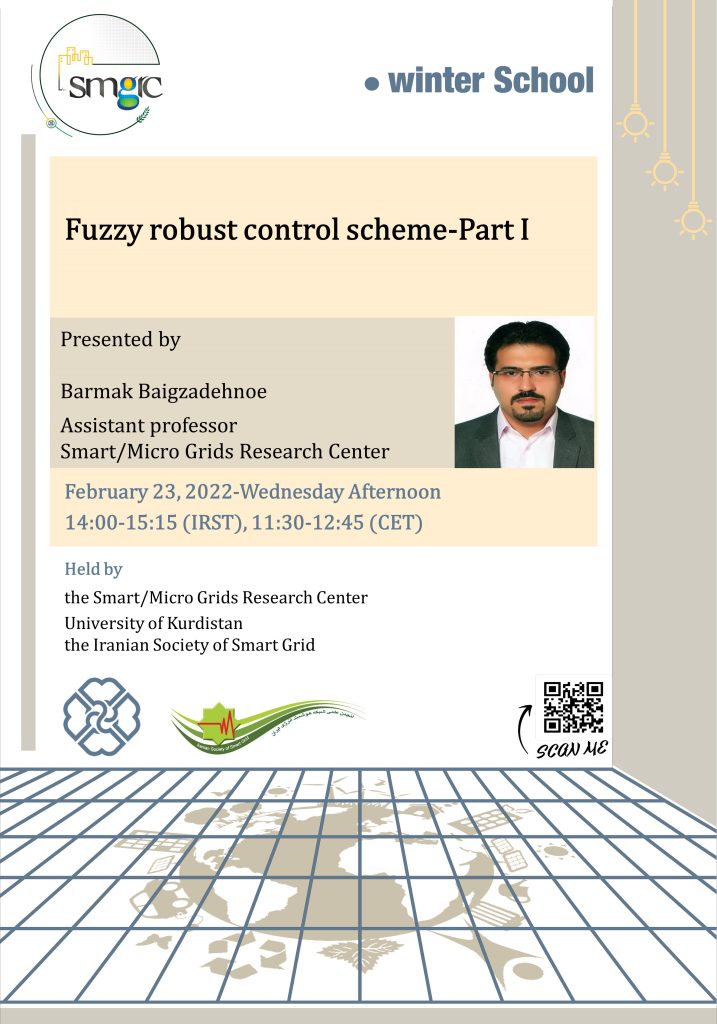
Fuzzy robust control scheme- Part I

Dr. Barmak Baigzadehnoe
Associate ProfessorThis lecture introduces Fuzzy Logic Control and its applications in complex nonlinear and uncertain systems. It covers fuzzy inference, fuzzification and defuzzification processes, with a focus on Takagi-Sugeno fuzzy controllers and fuzzy supervisory control schemes.
View details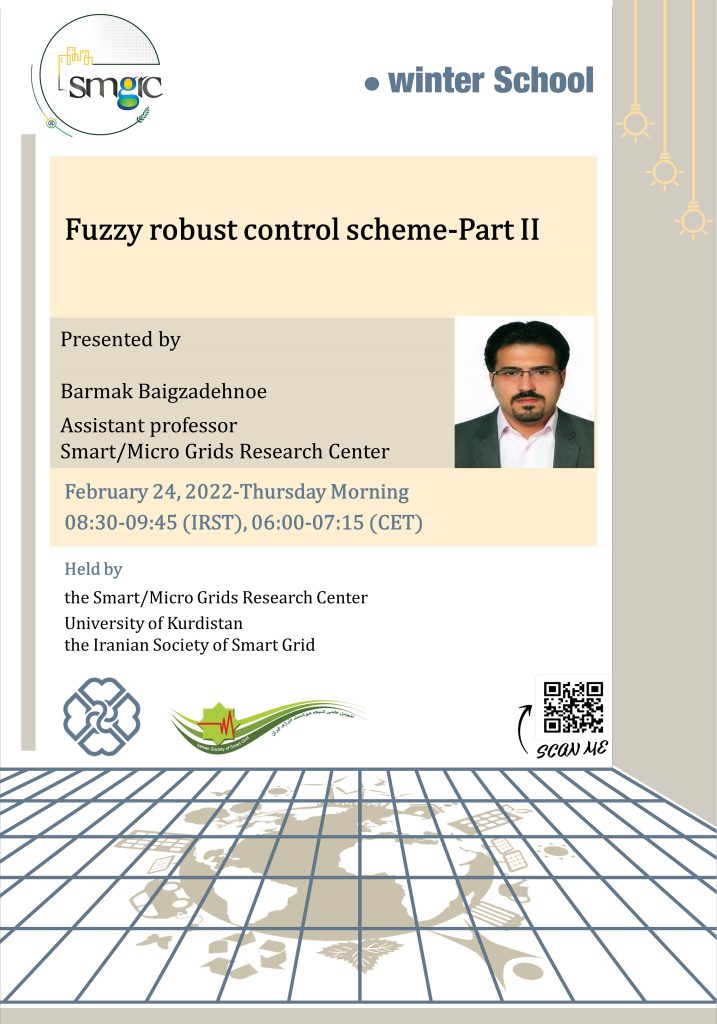
Fuzzy robust control scheme- Part II
Dr. Barmak Baigzadehnoe
Associate ProfessorThis lecture introduces Fuzzy Logic Control and its applications in complex nonlinear and uncertain systems. It covers fuzzy inference, fuzzification and defuzzification processes, with a focus on Takagi-Sugeno fuzzy controllers and fuzzy supervisory control schemes.
View details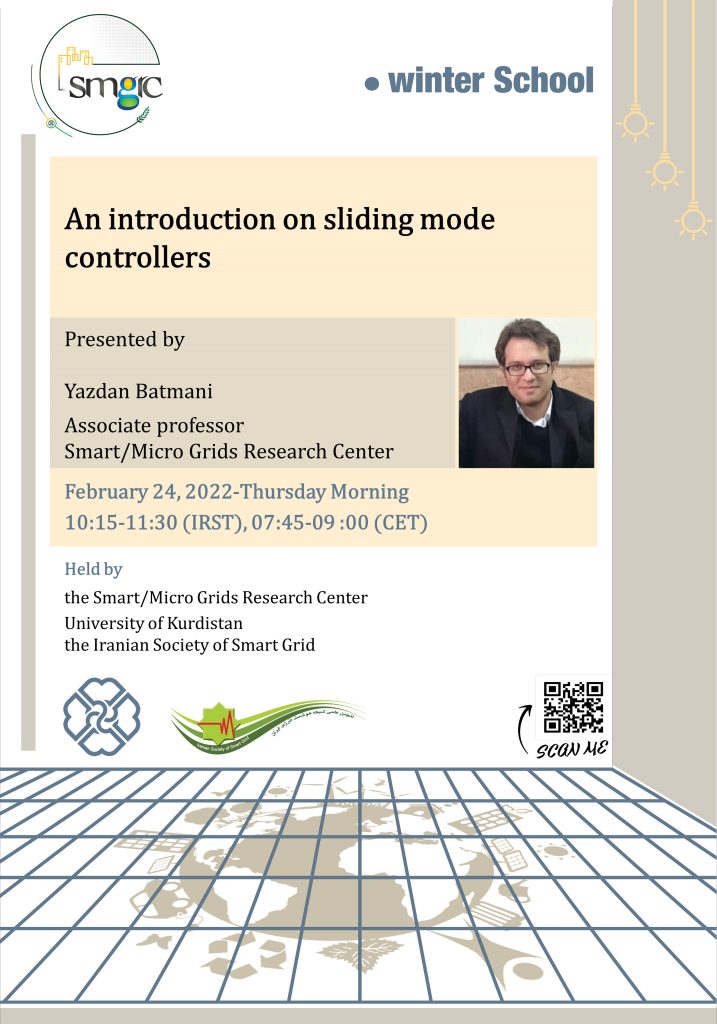
An introduction on sliding mode controllers
Dr. Yazdan Batmani
Associate ProfessorThis lecture introduces the fundamentals of Sliding Mode Control (SMC), a nonlinear robust control technique based on variable-structure control and sliding manifolds. It covers the two-stage design procedure, Lyapunov stability, and basic examples to help students develop robust controllers for dynamical systems.
View detailsAn Introduction on Robust Control
Hassan Bevrani received a Ph.D. degree in Electrical Engineering (Control Systems) from Osaka University in 2004. He is currently a full professor and the Founder of the Micro/Smart Grids Research Center (SMGRC) at the University of Kurdistan. Over the years, he has worked as an invited and visiting professor at several universities in Iran, Japan, Australia, France, Germany, and China. He is the author/coauthor of 10 international books, 18 book chapters, and over 500 journal/conference papers. Prof. Bevrani is a Fellow member of IEEE, the chairman of the Control Chapter of the IEEE Iran Section, and head of the Promotion Committee of the IEEE Iran Section. He was awarded the Allameh Tabatabaei Scientific Medal (National Foundation of Iranian Elites, 2025), an Outstanding Professor (Iran Ministry of Science, Research and Technology, 2022), IEEE Lifetime Research Award (IEEE Iran Section, 2025), and a Distinguished Professor in Electrical Engineering (Iran Academy of Science, 2025). Prof. Bevrani has also been awarded the prestigious Medal for the Promotion of Electrical Engineering Science by the Institute of Electrical Engineers of Japan (IEEJ) in 2026. His current research interests include microgrid operation and control, power system stability, and intelligent and robust control applications in the electric power industry.
About this course
In control theory, Robust Control contains a class of approaches that are used to controllers synthesis in the presence of uncertainties and disturbances. Therefore, robust control methods aim to achieve robust stability and/or robust performance in an uncertain environment including bounded modeling errors, parameters perturbation, and unmodeled dynamics. Although the early bases required tools go back to more than 80 years ago, the main start point of the theory of robust control took shape in the 1980s and 1990s. In contrast with an adaptive/intelligent control policy, a robust control policy is static, rather than adapting to measurements of variations, the structure of the controller is usually fixed, and it is designed to work assuming that certain parameters/variables will be unknown but bounded.
Historically and from the closed-loop transfer function perspective, a high open-loop gain, which its principle was already well understood by Bode and Black in 1927, leads to substantial disturbance rejection in the face of system parameter uncertainty. Thus, high-gain feedback is a simple example of a robust control method; because it allows simplified models of operational amplifiers and emitter-degenerated bipolar transistors to be used in a variety of different settings. But the major obstacle to achieving high loop gains is the need to maintain system closed-loop stability. Loop shaping may provide a solution to fix this challenge.
Some of the modern examples of robust control techniques are Hꚙ, structured singular value (μ), sliding mode control (SMC), robust LQG, quantitative feedback theory (QFT), and Kharitonov’s theorem. The control laws given by many robust control methodologies such as Hꚙ, H2, mixed H2/Hꚙ, and μ may be represented by high order transfer functions required to accomplish desired performance and stable robust closed-loop operation, simultaneously. Therefore, order reduction after the controller design process may be required.
In the first lecture, a short introduction on Robust Control with basic definitions, concepts, main differences with other control theorems, and a brief history are discussed. Therefore, this lecture will be useful for everyone who does not have a clear vision of Robust Control theory.
Videos
Uncertainty and loop shaping control design
Hassan Bevrani received a Ph.D. degree in Electrical Engineering (Control Systems) from Osaka University in 2004. He is currently a full professor and the Founder of the Micro/Smart Grids Research Center (SMGRC) at the University of Kurdistan. Over the years, he has worked as an invited and visiting professor at several universities in Iran, Japan, Australia, France, Germany, and China. He is the author/coauthor of 10 international books, 18 book chapters, and over 500 journal/conference papers. Prof. Bevrani is a Fellow member of IEEE, the chairman of the Control Chapter of the IEEE Iran Section, and head of the Promotion Committee of the IEEE Iran Section. He was awarded the Allameh Tabatabaei Scientific Medal (National Foundation of Iranian Elites, 2025), an Outstanding Professor (Iran Ministry of Science, Research and Technology, 2022), IEEE Lifetime Research Award (IEEE Iran Section, 2025), and a Distinguished Professor in Electrical Engineering (Iran Academy of Science, 2025). Prof. Bevrani has also been awarded the prestigious Medal for the Promotion of Electrical Engineering Science by the Institute of Electrical Engineers of Japan (IEEJ) in 2026. His current research interests include microgrid operation and control, power system stability, and intelligent and robust control applications in the electric power industry.
About this course
The robustness of closed-loop systems to disturbances and uncertainties has always been the central issue in feedback control. This lecture introduces some essentials of robust control theory. Uncertainty modeling and robust control synthesis using the loop shaping method is explained. The lecture makes a bridge between the fundamental knowledge of linear control systems and the main concepts of robust control theorems. It means that the analytical/graphical tools used in linear control systems such as Bode and Nyquist diagrams, as well as loop transfer function models are used to perform the synthesis elements of robust controllers. Both single-input single-output (SISO) and multi-input multi-output (MIMO) dynamic systems are considered as examples.
Various types of uncertainties that can arise in physical systems are briefly discussed. Some robust stability tests for systems under various model uncertainty assumptions are obtained through the use of the small gain theorem.
The lecture is focused on the basic robust and Hꚙ control theory. Therefore, the prerequisite for attending this lecture is some basic knowledge of classical linear control systems and state-space theory. Two important problems of robust control analysis (given a controller, then check closed-loop robustness) and robust control synthesis (design a controller to satisfy the closed-loop robustness) are addressed. The terms of nominal stability, nominal performance, robust stability, and robust performance are defined using the linear fractional transformation (LFT) representation.
It is explained how to formulate some performance objectives into mathematically tractable problems in terms of requirements on the sensitivity functions and/or complementary sensitivity functions. In this direction, the role of choosing appropriate weighting functions is emphasized, and a simple and effective method for selecting a first-order weighting function to track the performance objective or to model an unstructured uncertainty is addressed.
In this lecture, the application of Kharitonov’s theorem in control system analysis and synthesis is also introduced. In the end, the application of structured singular value theory for robust controller design in the presence of structured uncertainties is briefly discussed.
Videos
Practical 𝐻 ∞ and Mu control synthesis
Hassan Bevrani received a Ph.D. degree in Electrical Engineering (Control Systems) from Osaka University in 2004. He is currently a full professor and the Founder of the Micro/Smart Grids Research Center (SMGRC) at the University of Kurdistan. Over the years, he has worked as an invited and visiting professor at several universities in Iran, Japan, Australia, France, Germany, and China. He is the author/coauthor of 10 international books, 18 book chapters, and over 500 journal/conference papers. Prof. Bevrani is a Fellow member of IEEE, the chairman of the Control Chapter of the IEEE Iran Section, and head of the Promotion Committee of the IEEE Iran Section. He was awarded the Allameh Tabatabaei Scientific Medal (National Foundation of Iranian Elites, 2025), an Outstanding Professor (Iran Ministry of Science, Research and Technology, 2022), IEEE Lifetime Research Award (IEEE Iran Section, 2025), and a Distinguished Professor in Electrical Engineering (Iran Academy of Science, 2025). Prof. Bevrani has also been awarded the prestigious Medal for the Promotion of Electrical Engineering Science by the Institute of Electrical Engineers of Japan (IEEJ) in 2026. His current research interests include microgrid operation and control, power system stability, and intelligent and robust control applications in the electric power industry.
About this course
Most robust control methods suggest complex state-feedback or high-order dynamic controllers, which are impractical for industry practices. Furthermore, some experts have used new and untested robust control frameworks, which may have some difficulties in being implemented in real-world dynamic systems. In practice, simple proportional-integral-derivative (PID) controllers are common in the industry. However, since the PI/PID controller parameters are usually tuned based on experiences, classical, or trial-and-error approaches, they are incapable of obtaining good dynamical performance for a wide range of operating conditions and uncertainties.
In general, static output feedback (SOF) provides the simplest control structure. However, due to using simple constant gains, pertaining to the SOF synthesis for dynamical systems in the presence of strong constraints and tight objectives are few and restrictive. The existence of the SOF controller is shown to be equivalent to the existence of a positive definite matrix simultaneously satisfying two Lyapunov inequalities, where the determination of such a matrix leads to solving a non-convex optimization problem. Approaching a solution can be a difficult task, demanding a great computational effort.
In the other hand, for a variety of reasons, the optimal setting of PI/PID parameters is difficult. That is why most robust and optimal approaches suggest complex state-feedback or high-order dynamic controllers.
In this lecture, some important points on practical robust control synthesis are addressed. It is shown that necessary and sufficient conditions for SOF design, can be obtained in terms of two linear matrix inequalities (LMI) couples through a bilinear matrix equation. It is discussed how one can design a simple-structure robust controller in form of static gains or simple PI/PID controllers. The lectures are supplemented by several application examples including robust PI controller design for a load-frequency control unit in a power system, and designing a robust damping controller for a grid-forming converter in a microgrid.
The prerequisite for attending this lecture is some basic knowledge of classical linear control systems, linear algebra, as well as the previous lectures.
Videos
Quantitative feedback Theory
Yazdan Batmani received the B.Sc. degree in biomedical engineering from the University of Isfahan, Isfahan, Iran, in 2006, and the M.Sc. and Ph.D. degrees in control engineering from K.N. Toosi University of Technology, Tehran, Iran, in 2009 and 2014, respectively. From 2015 until 2019, he was an Assistant Professor with the Department of Electrical Engineering, University of Kurdistan, Sanandaj, Iran where he is currently an Associate Professor. His current research interests include nonlinear control systems, networked control systems, applications of control theory in Diabetes technology, power systems, and microgrids.
About this course
The quantitative feedback theory (QFT) is one of the most powerful techniques to design robust controllers in the frequency domain using the Nichols chart. In this method, the feedback is used to reduce the adverse effects of the uncertainty and provide some predefined performance specifications, simultaneously. This method has been successfully used in many practical systems and interesting results have been reported. Using the QFT, it is possible to design robust controllers for many classes of dynamical systems such as stable and unstable systems, minimum-phase and non-minimum-phase systems, time-delay systems, and multi-input multi-output (MIMO) systems. On the other hand, although new powerful control algorithms have been proposed and implemented for real systems, the PID controllers are still the most commonly used control strategy in practical industrial applications. The main reason for this popularity is the simplicity and flexibility of these controllers. The QFT can be used to tune the parameters of the PID controllers to achieve robust stability and performance. It should be mentioned that a robust PID controller has usually a much lower order than other robust controllers designed by well-known techniques.
The main objective of this lecture is to present the background of the QFT so that students can apply this theory to design general controllers regardless of the applications. After being familiar with the technique, they will be able to tune PID controllers, as basic but effective controllers. Examples and related toolboxes in Matlab will be used to convey a better understanding of the QFT. Due to the simplicity of the QFT, undergraduate and postgraduate students who are familiar with the linear control theory can participate in the lecture.
Videos
Linear quadratic optimal control design
Qobad Shafiee received his PhD degree in Electrical Engineering from the Department of Energy Technology, Aalborg University (Denmark) in 2014. He is currently an Associate Professor and Co-Leader of the Smart/Micro Grids Research Center at the University of Kurdistan, Sanandaj, Iran, where he previously served as a lecturer from 2007 to 2011. In 2014, he was a visiting scholar with the Electrical Engineering Department, University of Texas at Arlington, Arlington, TX, USA. He was a Post-Doctoral Fellow and a visiting professor with the Department of Energy Technology, Aalborg University, in 2015 and 2017, respectively. He was a visiting professor with the Department of Electrical Sustainable Energy at the Delft University of Technology, Netherlands in 2024-2025, where he continues his research collaboration as a senior researcher. He is author/coauthor of over 100 papers, one international book, and several book chapters. He is a Senior Member of IEEE, Associate Editor of the IEEE Transactions on Power Electronics, Associate Editor of the IEEE Transactions on Energy Conversion, and Associate Editor of e-Prime, Advances in Electrical Engineering, Electronics and Energy. His current research interests include stability, security, control, and operation of power electronics-based systems, converter-dominated power systems, and microgrids.
About this course
In many practical control problems, it is desired to optimize a given cost function while satisfying constraints involving dynamical systems. These kinds of systems typically fall into the area of optimal control, a centerpiece of modern control theory. Optimal control theory is a branch of mathematical optimization that deals with finding a control for a dynamical system over a period such that an objective function is optimized. This method is largely due to the work of some scientists in the 1950s, after contributions to the calculus of variations. The optimal control can be derived using Pontryagin’s maximum principle (a necessary condition) or by solving the Hamilton-Jacobi-Bellman equation (a sufficient condition). Optimal control methods comprise fundamental tools used in many engineering systems such as economics and logistics, aerospace systems, automotive industry, autonomous systems and robotics, bio-engineering, process control, and power systems.
The objective of this lecture is to familiarize the students with the theory and application of optimal control for linear and nonlinear systems. The focus of this lecture will be on linear-quadratic optimal control, a special case of the general nonlinear optimal control problem. For the sake of better understanding, some simple examples and numerical simulations will support the provided concept and theory. The lecture will be useful for undergraduate and postgraduate students with a background and basic understanding of control systems.
Videos
Robust model predictive control
Qobad Shafiee received his PhD degree in Electrical Engineering from the Department of Energy Technology, Aalborg University (Denmark) in 2014. He is currently an Associate Professor and Co-Leader of the Smart/Micro Grids Research Center at the University of Kurdistan, Sanandaj, Iran, where he previously served as a lecturer from 2007 to 2011. In 2014, he was a visiting scholar with the Electrical Engineering Department, University of Texas at Arlington, Arlington, TX, USA. He was a Post-Doctoral Fellow and a visiting professor with the Department of Energy Technology, Aalborg University, in 2015 and 2017, respectively. He was a visiting professor with the Department of Electrical Sustainable Energy at the Delft University of Technology, Netherlands in 2024-2025, where he continues his research collaboration as a senior researcher. He is author/coauthor of over 100 papers, one international book, and several book chapters. He is a Senior Member of IEEE, Associate Editor of the IEEE Transactions on Power Electronics, Associate Editor of the IEEE Transactions on Energy Conversion, and Associate Editor of e-Prime, Advances in Electrical Engineering, Electronics and Energy. His current research interests include stability, security, control, and operation of power electronics-based systems, converter-dominated power systems, and microgrids.
About this course
Model predictive control (MPC) is the class of advanced control techniques applied to ranging from the process industry to the automotive and power systems. MPC can deal with almost any time-varying process, multivariable systems with time-delays, constraints, and specifications, limited only by the availability of real-time computational power. MPC was developed in the process industries in the 1960s and ’70s, based primarily on heuristic ideas and input-output step and impulse response models. The basic principle is to solve an open-loop optimal control problem at each time step. The decision variables are a set of future manipulated variable moves and the objective function is to minimize deviations from the desired trajectory; constraints on manipulated, state, and output variables are naturally handled in this formulation. Feedback is handled by providing a model update at each time step and performing the optimization again. The main advantage of MPC is the fact that it allows the current timeslot to be optimized while keeping future timeslots in the account.
Linear MPC, Nonlinear MPC, Explicit MPC, Hybrid MPC, Stochastic MPC, and Robust MPC are some of the most well-known variants of model predictive control. Robust MPC is an improved form of MPC that is intrinsically robust in the face of uncertainty. The main purpose of robust MPC is to devise an optimization-based control synthesis method that accounts for the interactions of the uncertainty with the system, constraints, and performance criteria in a theoretically and computationally tractable way.
The primary objective of this lecture is to provide an introduction to the theory and application of model predictive control with a focus on robust MPC. For the sake of better understanding, the provided concept and theory will be supported by simple examples and simulations. The lecture will be useful for undergraduate and postgraduate students with a background and basic understanding of control systems.
Videos
Fuzzy robust control scheme- Part I
Barmak Baigzadehnoe was born in Sari, Iran, in 1980. He received the B.Sc. degree in control engineering from Tehran University, Tehran, Iran in 2004, the M.Sc. degree in control engineering from K.N. Toosi University of Technology, Tehran, Iran in 2007, and the Ph.D. degree in control engineering from the Babol Noshirvani University of Technology, Iran, in 2018. He is an assistant professor of control engineering in the engineering faculty of Kurdistan University since 2021. His research interests are adaptive and nonlinear control, large-scale systems, fuzzy logic systems, and intelligent methods
About this course
In the early 1970s, fuzzy systems and fuzzy control theories added a new dimension to control systems engineering. From its beginnings as mostly heuristic and somewhat ad hoc, more recent and rigorous approaches to fuzzy control theory have helped make it an integral part of modern control theory and produced many exciting results. Fuzzy logic control is a methodology bridging artificial intelligence and traditional control theory. Fuzzy Logic can address complex control problems, such as robotic arm movement, chemical or manufacturing process control, antiskid braking systems, or automobile transmission control with more precision and accuracy, in many cases, than traditional control techniques. Fuzzy control is a methodology for expressing operational laws of a system in linguistic terms instead of mathematical equations
Fuzzy logic imitates the logic of human thought, which is much less rigid than the calculations computers generally perform. The Fuzzy Logic methodology comprises three phases. 1) The russification phase is a transformation of input variables to linguistic ones. 2) The fuzzy inference maps input linguistic variables onto output linguistic variables on the base of a system of fuzzy rules of the type “IF A THEN B”. 3) The defuzzification phase converts the weighted values of output linguistic variables obtained as a result of fuzzy inference to output variables.
Robust fuzzy control systems have been widely used for automatic control of complex processes. This type of control system, being a qualitatively new class of control systems, proved to be very effective in the control of complex nonlinear uncertain dynamic objects for which the classical deterministic and stochastic controllers are unable to operate. A fuzzy controller is a knowledge-based controller in which fuzzy logic is used to represent knowledge and logical inference. The aim of this course is to introduce the most well-known fuzzy control methods such as Takagi-Sugeno fuzzy controller and fuzzy supervisory control scheme which have had the greatest success and acclaim. Moreover, this course will be useful for power and control engineers.
Videos
Fuzzy robust control scheme- Part II
Barmak Baigzadehnoe was born in Sari, Iran, in 1980. He received the B.Sc. degree in control engineering from Tehran University, Tehran, Iran in 2004, the M.Sc. degree in control engineering from K.N. Toosi University of Technology, Tehran, Iran in 2007, and the Ph.D. degree in control engineering from the Babol Noshirvani University of Technology, Iran, in 2018. He is an assistant professor of control engineering in the engineering faculty of Kurdistan University since 2021. His research interests are adaptive and nonlinear control, large-scale systems, fuzzy logic systems, and intelligent methods
About this course
In the early 1970s, fuzzy systems and fuzzy control theories added a new dimension to control systems engineering. From its beginnings as mostly heuristic and somewhat ad hoc, more recent and rigorous approaches to fuzzy control theory have helped make it an integral part of modern control theory and produced many exciting results. Fuzzy logic control is a methodology bridging artificial intelligence and traditional control theory. Fuzzy Logic can address complex control problems, such as robotic arm movement, chemical or manufacturing process control, antiskid braking systems, or automobile transmission control with more precision and accuracy, in many cases, than traditional control techniques. Fuzzy control is a methodology for expressing operational laws of a system in linguistic terms instead of mathematical equations
Fuzzy logic imitates the logic of human thought, which is much less rigid than the calculations computers generally perform. The Fuzzy Logic methodology comprises three phases. 1) The russification phase is a transformation of input variables to linguistic ones. 2) The fuzzy inference maps input linguistic variables onto output linguistic variables on the base of a system of fuzzy rules of the type “IF A THEN B”. 3) The defuzzification phase converts the weighted values of output linguistic variables obtained as a result of fuzzy inference to output variables.
Robust fuzzy control systems have been widely used for automatic control of complex processes. This type of control system, being a qualitatively new class of control systems, proved to be very effective in the control of complex nonlinear uncertain dynamic objects for which the classical deterministic and stochastic controllers are unable to operate. A fuzzy controller is a knowledge-based controller in which fuzzy logic is used to represent knowledge and logical inference. The aim of this course is to introduce the most well-known fuzzy control methods such as Takagi-Sugeno fuzzy controller and fuzzy supervisory control scheme which have had the greatest success and acclaim. Moreover, this course will be useful for power and control engineers.
Videos
An introduction on sliding mode controllers
Yazdan Batmani received the B.Sc. degree in biomedical engineering from the University of Isfahan, Isfahan, Iran, in 2006, and the M.Sc. and Ph.D. degrees in control engineering from K.N. Toosi University of Technology, Tehran, Iran, in 2009 and 2014, respectively. From 2015 until 2019, he was an Assistant Professor with the Department of Electrical Engineering, University of Kurdistan, Sanandaj, Iran where he is currently an Associate Professor. His current research interests include nonlinear control systems, networked control systems, applications of control theory in Diabetes technology, power systems, and microgrids.
About this course
Sliding mode control (SMC) is a nonlinear robust control technique that achieves control objectives by designing a discontinuous control signal. In this method, the system is forced to follow a predefined sliding manifold and stay on it. Since the control law can switch from one continuous structure to another based on the current position in the state space, the SMC is a variable structure control method. The design procedure of the SMC is a two-stage process. The first phase is to design a sliding manifold, and the second one is to determine a switching control law that forces the trajectories of the system onto the sliding manifold and maintains the trajectories on it. As a powerful and systematic method, not only is the SMC widely extended to a lot of different classes of dynamical systems but also is utilized to design robust controllers in many practical systems.
The main objective of this lecture is to present the background of the SMC so that students can apply this theory to design robust controllers for some basic classes of dynamical systems. Since there are many extensions of the idea of the SMC, the lecture will only focus on the main concepts by following some rudimentary examples. Due to presenting some related preliminaries such as the Lyapunov stability, undergraduate and postgraduate students who are familiar with the linear control theory and state-space can participate in the lecture.
Videos
Timetable
Day 1, 22 Feb. Tuesday
6 sessionsDay 2, 23 Feb. Wednesday
5 sessionsDay 3, 24 Feb. Thursday
3 sessionsNo session matches your search.
Session Gallery
Protected Files
These files are for registered participants. Enter the password you received to unlock them.
Recorded Videos
FAQ & Contact
01Was the school held in person?
No. The school was held virtually, as an online program.
02Where can I watch the sessions?
The recorded sessions are available in the Recorded Videos section, hosted on Aparat.
03Where are the slides and MATLAB files?
All course materials are collected in the Downloadable Files section.
04Will there be another school?
New Winter and Summer Schools will be announced on this page.
Be the first to know about the next school
Leave your email and be the first to hear when the next Winter or Summer School opens for registration.